

Today, I saw a snippet from an article about cave paintings that flooded me with so much emotion that I nearly cried, so of course that’s what we’re gonna talk about this week. I’ll share the article I saw later in this post, but before we branch out into the deep stuff, lets get down to the basics.
What counts as art?
According to the Cambridge Dictionary, art is “the making of objects, images, music, etc. that are beautiful or express feelings” or “an activity through which people express particular ideas”. Britannica defines art as, “a visual object or experience consciously created through an expression of skill or imagination”. Me? I define art as a mode of self expression meant to evoke some kind of emotion or message in the viewer or release an emotion for the creator.
Art can encompass anything from paintings, sculpture, performance, written word, textile work, etc.. To me, as long as it makes you feel something and was created by a human soul, it can be considered art. There are many debates on what “counts” as art, but I find those arguments to be, frankly, a bit pretentious and often sexist and racist. Besides, that could be a whole essay on it’s own, so we’re not gonna get into that today. What I will say is that, in my opinion, the more broad our definition of art is, the more opportunities and avenues we give people to express themselves. Besides, creating art is necessary.
Why we need art
When I told my boyfriend about this article I saw about cave paintings, he shared this video with me about cave paintings and how it’s human nature to create art.
The Past We Can Never Return To – The Anthropocene Reviewed
This video also almost made me cry. Something about seeing how we have always made art and knowing that we will always make art fills me with this existential emotion, like reaching a hand out in both directions to my ancestors and my descendants and feeling them reach back.
In this video, when talking about the handprints and paintings seen in caves, John Green, the teller of this story, says, “These hand stencils remind us of how different life was in the distant past [...] But they also remind us that the humans of the past were as human as we are, their hands indistinguishable from ours. These communities hunted and gathered, and there were no large caloric surpluses, so every healthy person would have had to contribute to the acquisition of food and water. And yet, somehow, they still made time to create art, almost as if art isn’t optional for humans.”
Art isn’t optional for humans. That quote... that quote shook me to my core. Because, at least to me, in my life, that’s entirely true.
If I go too long without creating art in some way, shape, or form, I start behaving like someone going through drug withdrawals. I become depressed, I feel antsy, I can’t focus, I get irritable. For me, creating art is a necessity. It is not optional. And to know I’m not alone in that feeling, that even the first humans felt this need, it makes me feel like I’m a part of something bigger, like I can feel the stardust we’re all made of.
The people of today have not outgrown the need to make art; it’s something that’s innate in us. Art not only helps us connect to and express our own emotions, but it also helps us connect to each other. We see that our similarities outweigh our differences, we see our experiences are not wholly unique, and we see that we are never truly alone.
The art of our past
All over the world, archeologists have uncovered cave paintings, the oldest found being over 50,000 years old. Cave paintings often depict things of nature, such as animals and humans, crafted by skilled and careful hands. But, in some caves, lower on the walls, you can find less skilled work. That work is a lot more indicative of the work of a small child.
In this article by Andrew Curry, Curry discusses how experts found cave paintings in the Las Monedas Cave in Spain that depicted just this. Based on the experts’ analyses, the art was comparable to that of modern toddlers with “the furiously scribbled circles and push-pull lines typical of 3-year-olds just learning to control their bodies [...] or the wobbly, right-angled figures of slightly older kids beginning to master fine motor skills.”
They also came to the conclusion that, because the children’s art was near but separate from the art by adults, it suggests that they were making art simply for the sake of making art. The children being allowed to participate in this making of art means that, most likely, art wasn’t some sort of ritual or exclusively religious or informative thing. Instead, art was made for the same reasons we make it today: for fun and self expression.
In this article by Caroline Davies, research suggests that ancient peoples not only let their children scribble on the walls for fun, but they also taught their children how to make art. (This is the article that almost made me cry by the way.)
Finger fluting (art made by “running fingers over soft red clay to produce decorative crisscrossing lines, zig-zags and swirls”) made by the small hands of children were found high on the walls and ceilings, suggesting they were held up by an adult so they could reach. There’s also flutings suspected to be by a toddler that suggest the child’s hand was guided by an adult’s. “The art shows us this is not an activity where children were running amok. It shows collaboration between children and adults, and adults encouraging children to make these marks. This was a communal activity.”
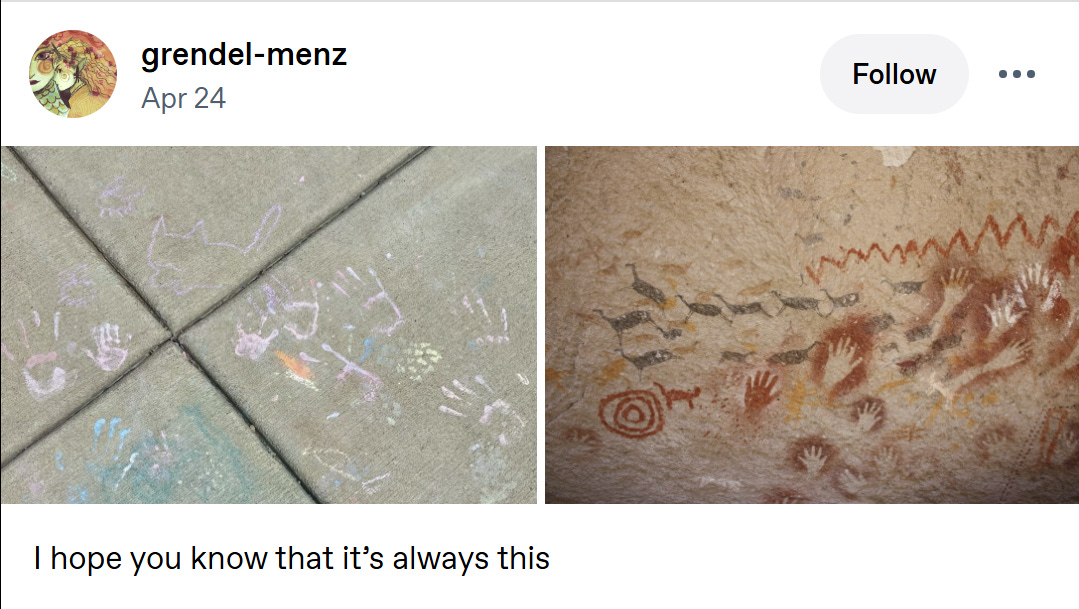
This art of the past mirrors the art of our individual pasts to an amazing extant. I’m sure if you remember far back to your days of preschool, or even back to the early art of your children, you’ll find a lot of it was based around the hand. Hand prints, hand turkeys, finger paintings. And of course, we can’t forget the inspired scribbles and squiggles and swirls of crayon we made in coloring books (and maybe sometimes on the walls). Children from over 50,000 years ago are the same as children now. We make the same art. We have the same desire to make the same art. For something to last thousands and thousands and thousands of years must mean something. Art is a part of us. To quote grendel-menz on Tumblr, “I hope you know that it’s always this”.
No such thing as “bad” art
Now for a bit of a tangent, but don’t worry, it’s still relevant. Remember when I said that anything can be considered art as long as it makes you feel something and was created by a human soul? Well, I said the “human soul” bit for a reason.
Let me not get ahead of myself. I don’t think any art is objectively “bad”. Good and bad are subjective. Art is subjective. To think that something can only be considered art if you yourself consider it beautiful is, in my opinion, a very strange thing to think. How many times has something been ridiculed by one group but praised by another? How many times has someone’s art gotten appreciation only after they died? Does the art lose or gain inherent value based on whether or not you personally like it? Of course not! You’re allowed to dislike something that I like, and I’m allowed to dislike something you like. Having a negative opinion of something doesn’t mean it’s no longer art. That goes for all art. Except, of course, AI “art”.
The only bad art, is AI art, mostly because, to me at least, AI “art” can’t be considered art. Art needs to be created by a human in order to be human art. Generative AI cannot think for itself, it can’t be creative, it cannot create original thoughts. All it can do is take pieces from real people, bastardize them, and reproduce a decent approximation of human art.
Many defenders of AI “art” will say that generative AI makes art “accessible”. To them, instead of being a learned and practiced skill, art is an inherent talent. Either they do not want to practice to improve, or they think they can’t practice to improve. Either way, they’re wrong. Art has always and will always be accessible. There are people who don’t have arms who make art, colorblind artists, paralyzed artists, blind artists, and the list goes on. Not liking your own art and refusing to practice to get it to a place where you do like it does not make art inaccessible. Even if you do not like your art, you still made art. That is a fact that cannot be changed.
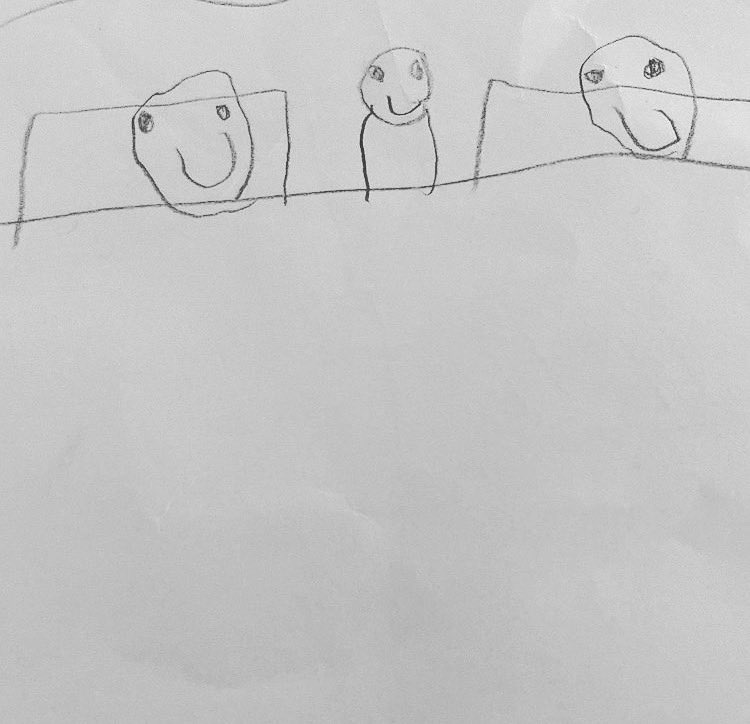
This is why I say what should be considered art needs to be broadened. If we limit art to only things an individual sees as beautiful or impressive, then we lose an entire subsection of meaningful and valuable art. Many people do not see embroidery or sewing or collage or scrapbooking or quilting as art because they do not find these things impressive (this is almost always because these forms of art are primarily made by women). To say that art is inaccessible and then turn around and limit what you consider to be art is only to limit yourself and your own expression. No matter how bad you think your art is, it will always be more meaningful and beautiful and emotional than anything generative AI can produce. To loosely quote a deactivated Tumblr account, AI art defenders will say art is inaccessible, meanwhile the most impactful piece of art I’ve seen recently is “My son’s drawing of ‘safe’”.
Despite everything, it’s still us
The point of this post (which might as well be an essay at this point) is that art is something that we have always done as humans. It connects us to our past, by which I mean both our childhoods and our ancestors. It’s something we’ve always felt was necessary to do in spite of our hardships. It’s what makes us human. It’s what’s always made us human.
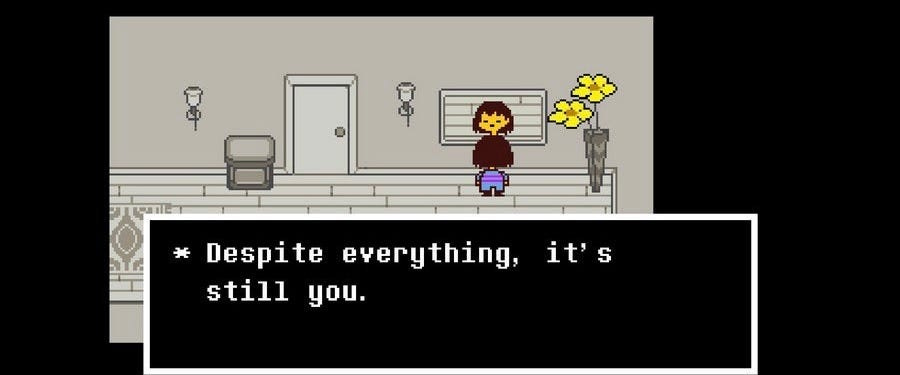
If you haven’t realized already, the title of this section and this post as a whole is a reference to the game Undertale. There’s a mirror that you can interact with both at the beginning and the ending of the game. When you interact with it at the beginning of the game, the text box reads, “It’s you!” At the end of the game, if you interact with it, the text box says, “Despite everything, it’s still you.” I think that quote is relevant to this post and the concept of the everlasting nature of art. Despite everything, despite the horrors, the hardships, plagues, poverty, famines, natural disasters, loss, death, birth, sickness, disability, war, despite it all, we still make art. Despite it all, it’s still us.
Links to my Sources and References
How Art Makes Us More Human: Why Being Creative is So Important in Life - Mallory Shotwell
Art is an Essential Part of the Human Experience - Shelby Skumanich
Stone-age toddlers had art lessons, study says - Caroline Davies
‘Enigmatic’ cave art was made by ice age children - Andrew Curry
The Importance of Art & Why it Matters - Eden Art
World’s oldest cave art found showing humans and pig - Pallab Ghosh
Empowering Creativity: 10 Artists with Disabilities - Casandra Visser
The Past We Can Never Return To – The Anthropocene Reviewed - Kurzgesagt – In a Nutshell
Post by passionpeachy-deactivated202312 on Tumblr
Post by grendel-menz on Tumblr
Post by @eohiggins on X (Twitter)